Lingo
Slang
Fluently
Think of it as a spill of syllables – no spitting in here, please
Language changes
slowly, then all at once
Every dialect contains a grammar nobody wrote down. Children master it before entering school — absorbing rules through exposure alone, making no errors they were never corrected for.
Languages don’t decay — they drift. A vowel shifts in a thousand mouths before anyone notices, and by the time a grammarian writes it down as a rule, the speakers have already moved on. The great vowel shift reshaped English so thoroughly that a speaker from 1350 would not recognize the speech of 1600 as the same language. Words we still spell the same — time, house, name — once rhymed with entirely different partners. The spelling is a fossil record of sounds that no living mouth makes, and every silent letter is a phoneme that gave up sometime before the printing press fixed everything in place.
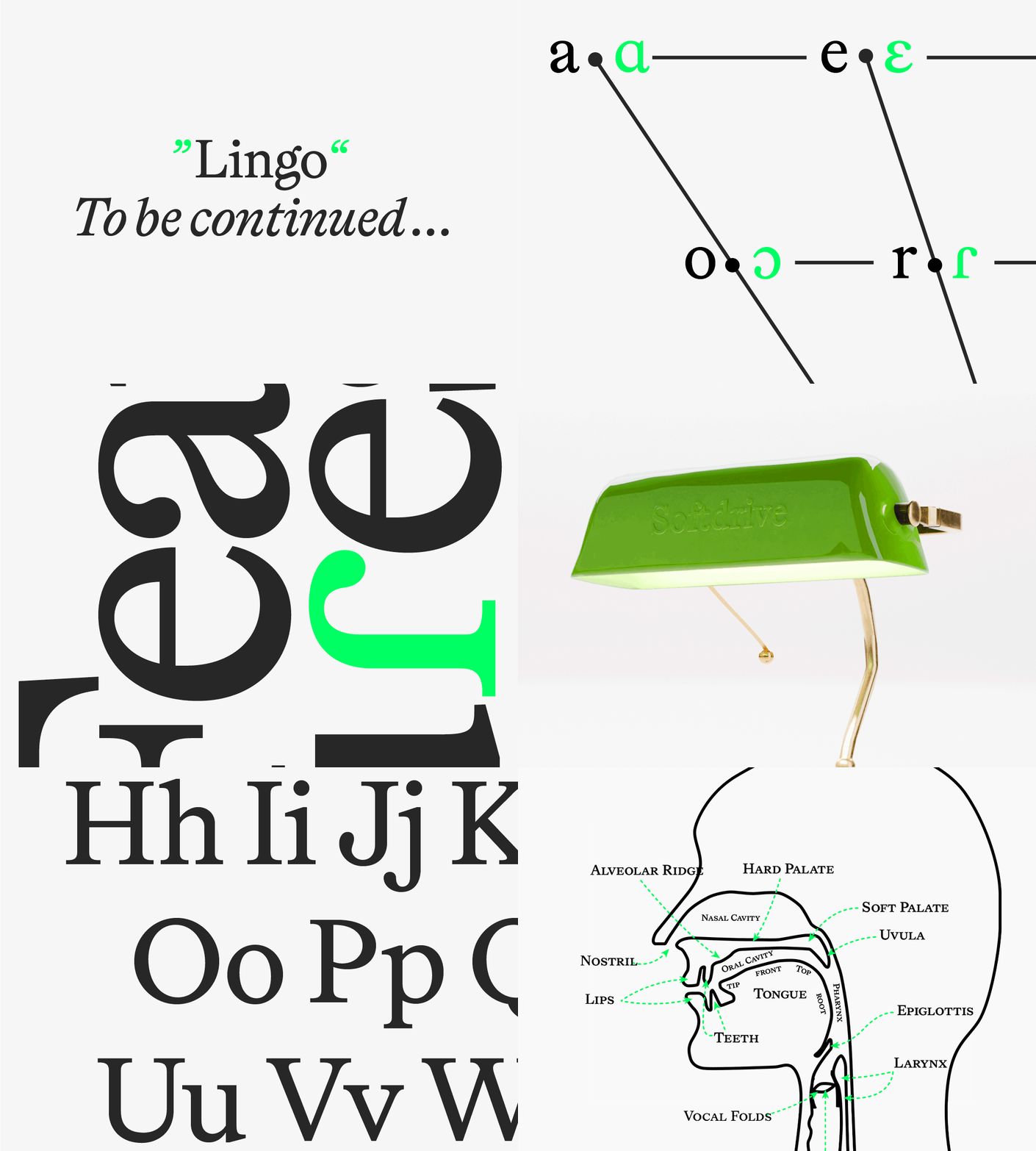
The International Phonetic Alphabet assigns a unique symbol to every sound a human voice can make. Clicks that exist in no European language. Tones that carry grammatical weight. Subtle distinctions between dental and alveolar consonants, between rounded and unrounded vowels, between stressed and unstressed syllables. A transcription in IPA is not a spelling — it is a blueprint of the sound itself: the precise movement of tongue, lip, and airstream that produces what we call a word. Two words can be spelled identically and transcribed differently; two words can look nothing alike and share the same phonological structure entirely.
Children learn language by listening to imperfect examples of it. No parent speaks only in grammatically correct sentences, and no child hears language free from background noise, interruption, and ambiguity. Yet within a few years, every child arrives at a grammar sophisticated enough to produce sentences they have never encountered — to understand questions they have never been asked. Whatever the mechanism is, it is not memorization. Linguists have been arguing about what it actually is since the 1950s, and the debate shows no signs of resolving. The children, for their part, are not waiting for an answer. They are already speaking.
Dialect is not an error. It is a fully formed linguistic system with its own phonology, grammar, and vocabulary, spoken by real communities who communicate perfectly well within it. What gets called a dialect and what gets called a language is rarely a linguistic question — it is almost always a political one. Mutual intelligibility is not a reliable test: Serbian, Croatian, and Bosnian are mutually intelligible but classified as separate languages. Cantonese and Mandarin are classified as dialects of Chinese but are not mutually intelligible at all. A language, the saying goes, is a dialect with an army and a navy. The tongue does what it needs to do. The politics follow later, arguing over what it means. Meanwhile, somewhere, a community is speaking a grammar no one has written down, in a voice no one has recorded, passing it forward in the only way language has ever actually survived: by being spoken, again and again, to someone who listens.
Thin Italic
Light Italic
Regular Italic
Medium Italic
Bold Italic
Black Italic
Lingo Thin
Lingo Light
Lingo Regular
Lingo Medium
Lingo Bold
Lingo Black
Lingo Thin Italic
Lingo Light Italic
Lingo Regular Italic
Lingo Medium Italic
Lingo Bold Italic
Lingo Black Italic
Loading…
Basic Latin


Latin-1 Supplement


Latin Extended-A


Latin Extended-B


IPA Extensions


Spacing Modifier Letters


Spacing Accents


Greek & Coptic


Smallcaps


Ligatures


g Alternates


SS01 – Alpha Style a


SS02 – Epsilon Style e


SS03 – Body g


SS04 – Simple g


SS05 – Open o


SS06 – Fishhook r


SS07 – Upsilon u


SS08 – Gamma y


SS09 – Ezh z


SS10 – Epsilon E


Oldstyle Figures


Superscript & Subscript


Fractions


Roman Numerals


Circled Figures


Slashed Zero


Punctuation & Spacing


Tabular Figures


Currency


Mathematical Operators


Arrows & Geometric


Symbols


Release Note
More Typefaces